Showing posts with label weightlifting. Show all posts

Tuesday, August 5, 2014

What I Learned from the 2014 Crossfit Champions

So here are a few takeaways from the Crossfit Games winners two weeks ago that are applicable to anyone competing in strongman. Coaching, diet, strength, and weak point training are the basics here. I'm sure if you hooked these four horses up to a carriage it wouldn't move because they are all dead but perhaps you are missing part of the picture. For me, this confirmed what I already knew and reassured me I'm on the right track.


1. Coaching
While Froning appears to be the roguish cowboy who follows no set plan and basically trains as he wants, Leblanc-Bazinet's coaches program for her. I think this is an important tool that we can easily forget to use. If you pay attention you will also see that many pros and high level amateurs in strongman either have a coach who assists with or designs their program. Plus, there are many more that train with a group that pushes them past their capabilities should they train or plan their training alone. That extra watchful eye and authority you must be accountable to beyond yourself can push you to new heights and expand your own wealth of training knowledge.

2. Diet 
Fucking eat already.  Leblanc-Bazinet eats like a bodybuilder! She claims to consume 200 grams of protein a day in about six meals! Ok, two of those meals are shakes, but this girl is putting away some calories. She also said in interviews that her main carb source is the sweet potato. High protein, sweet potatoes... Sounds familiar? 
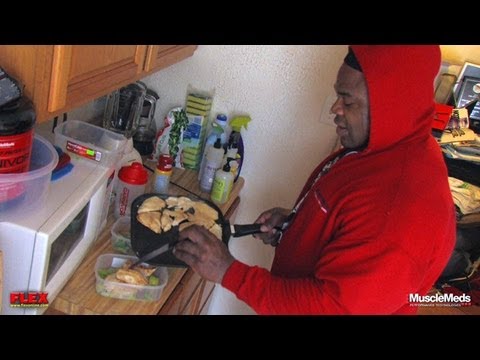
You've seen this.  After the chicken and the vegetables come the sweet potatoes.

As for Froning, he does whatever he wants. Again. Like Leblanc-Bazinet, he relies on lots of protein shakes to get through the day, but at night eats whatever he wants. This doesn't include bread or pasta, which he doesn't like (wtf?). But he does like lots of peanut butter which he washes down with whole milk.

Another huge front squat for Leblanc-Bazinet

3. Strength base. 
Did you know Leblanc-Bazinet did a double bodyweight front squat! 265 at 130! That is fucking strong. The bulk of her training is also barbell training, either building strength with squats and deadlifts or working on her weightlifting technique, as she reports in a recent interview: "I don’t even do a lot of wod … it is a lot of strength training and skill work… some aerobic too... I might do typical sod [skills] 4 times a week but mostly strength work…"
Froning is also strong, showing us what he is capable of with that 377 overhead squat in the games. But he doesn't have a plan for getting there so we'll just not talk about him anymore...

"I just do what I want, dude."

4. Weak point training.
The whole idea of this sport of fitness is to be well-rounded. At least that's the definition of fitness according to some of the the commercials aired during the games. For Leblanc-Bazinet, as a smaller athlete, she needs to be efficient and strong. She has repeated in interviews that weak points are the focus of her training and thus you can see how, being smaller, strength is key. Her coach had this to say about the matter:
"I wouldn’t say that Camille had any major weaknesses. She’s a smaller athlete, so she needed to get stronger to handle the heavier loads we expected [and saw] at Regionals. She had already started to focus on Olympic lifting and was making great progress. We kept that focus and added in supplemental strength and skill progressions. We worked a lot on cycling moderate to heavy loads for multiple reps, and we carved out time for her to continue to develop her gymnastics skills outside of the pressure of the clock. We structured her energy-systems training so as not to impact her strength development and then moved into building her aerobic base later in the season.”(1)

There you have it. After the Games, I looked into the winners and I wasn't surprised to find out what I did. In strongman or any other sport, you must train, eat, and problem solve to reach the highest levels and do so consistently.

Thursday, July 10, 2014

Lessons in Grip Training, Part 1

Beginning to Accomplish Feats of Strength

After dropping the farmers handles before the finish line for the second time in a  strongman competition I started looking for ways to improve my grip and for some reason that meant doing more than heavy farmers. I knew nothing about grip training except what people had told me and that was limited to wrist rollers and grippers. So I started looking around online to see what the best of the best did for grip and I found a whole world of training that I still, two years later, have just begun to scratch the surface of. 

Like any ignorant beginner, I watched some videos and read some blogs and quickly looked around to see what I could emulate. We had an Ironmind Rolling Thunder at the gym as well as axle bars. We had some grippers too. But I wanted to do something a little extra so I went to Duane Reade and bought some playing cards. This was to be my first "feat of strength." 

Over and over I watched Adam Glass tear mini decks in seconds. I saw another vid of lightweight pro strongman Zack McCarley tear two decks. I gleaned what I could from these and humbly started with a suit and continued to add 4-5 cards a day until I reached a full deck. It took me about 4 weeks to get through a whole deck but it was braced, meaning the deck was against my body. Then I started tearing away from my body and it was about two months until I could tear a deck in that fashion. 

I learned that all decks are not created equal. Duane Reade's Play Right brand was like tissue paper compared to Bicycle; and Bee, found in all the bodegas of NYC, was a total bitch. Even stranger still was the variances between decks of the same brand so every now and then my decks from Duane Reade would put up greater resistance.

I also learned that frequency was everything. If I tore every day or every other day I could eventually get through decks in about 30 seconds even with Bicycles. The video below was taken about five months after I started tearing and my frequency was not as high as it was a couple months before. It took me about a minute which among grip specialists is analogous to a year.

I will be much stronger in my next grip video. And bearded.

I wasn't limiting my adventure to cards. I pursued a second "feat of strength": nail bending. Shortly after I bought my first deck of cards I ordered my first bag of nails. When it arrived I watched some more YouTube videos and went to work. At first I wanted to bend with the reverse grip method since it was the hardest, requiring tremendous hand and wrist strength. This involves stabilizing the nail with one hand while the other hand takes an opposing grip and pulls it back over the top of your stabilizing thumb. It took a minute of straining to go back to a double overhand grip because I wanted to bend the heavier nails in my lifetime. 

Pat Povilitis can twist your head off.

Starting with the color coded Ironmind nails I found the White and
Green too easy and the Yellow really damn hard. It took me a couple of weeks to bend a Yellow and a few more weeks after that to bend the Blue. 

That left the imposing Red nail and that wasn't going anywhere. 

I soon ordered more nails and some bolts from Fat Bastard Barbell Co. to fill in the gap between the Blue and Red nails.  I organized and labeled them all from easiest to hardest and went to work again. This time, I managed to get to a grade 5 bolt and then to a grade 8 bolt.

Blue and Yellow nails among the lesser grades, some cards, and IronMind wraps.

Frequency was everything, but now it was hindering progress. After all this tearing and bending, spanning a solid six months, I started to accumulate lots of pain by overtraining.  

My method of bending, double overhand, put a tremendous stress on the tendons and joints of my upper body.  A lot of the action was isometric because a lot of the time I failed to bend the next hardest nail or bolt. My elbows and shoulders began to hurt at the joints. 

I tore my cards by stabilizing, or choking, the deck with my left hand and peeling the top off with my right hand. This looks like a heavy, tense cross body concentration curl. My right brachioradialis was killing me. My weight training was beginning to suffer. Picking up stones hurt. Pressing hurt. I had to lay off my destructive ways.

Now, I should reiterate that I did all of this to help me become a better strongman athlete. Instead I became an achy strongman athlete with some average "feats of strength" to impress the family at Christmas. And none of the things I bent and tore helped me with farmers...

This all leads me to my point and the subject of the next part of this article, which I will post soon:

1. Prepare your body for grip training before you delve into it. Adjust your training volume and intensity to handle the stress of grip work. I must add that bending and tearing was not a waste of time and didn't make me weaker, but overtraining did. The point: prepare yourself for added stressors and don't overtrain!

2. Understand that there are different types of grip strength and being good at one modality doesn't ensure success with another.

3. Success in grip sports like any endeavor takes a long time and a lot of hard work. This point, however obvious, always seems to get lost on us.

Lots of hard work and then two hours with Chris "Wonder" Schoeck and I destroyed more steel and cards than I thought possible. RSVP now for Chris' seminar at Global Strongman Gym on August 17.

If you want to accomplish some "feats of strength"of your own or get into grip training, check out these sites first:

Diesel Crew (Jedd Johnson)

Chris "Wonder" Schoeck (Chris is the subject of the documentary Bending Steel and is featured in the NY Times and NY Post. Also, contact us at Global Strongman Gym to RSVP for his first seminar.)


The Gripboard (forums with tons of links and info)

Sunday, June 29, 2014

10 Tips for New Strongmen and Strongwomen

Strongman is rapidly growing and whether or not you plan to compete or plan to spice up your current training program, every beginner seems to make the same mistakes.  Though there are more than what I have listed below, I think these 10 are good to start with.

1. Curling the stones. 

After you lap an atlas stone and prepare to load it, it is imperative that you adjust your hand position. You need to put them over the stone with your elbows pointing out and slightly upward. If they are pointing down, you are going to use too much biceps power and put yourself at high risk for a tear. Don't curl the stones!

For more info on stone training, check out this old post: 

2. Curling the log

This is similar to the above in that you don't want to put undue stress on your biceps. When the log is lapped, the handles are facing upward and are slightly turned out. Sit back so the top of your abdominals touches the log. Pull the log in while pushing your stomach out. Now extend your hips violently maintaining that upper body tightness and the log should roll right up onto the top of your chest. 

When you mess this up, you don't pull the log in with your lats and it separates from your core on the clean. This forces your biceps to make up the slack. This will hurt when done over and over again.

3. Yoke height

If you set the pin too high you will be risking dragging and dropping it. If you set it too low, you now have to do too much of a squat to pick it up. That can be taxing and it takes more time to get moving.

While there are many kinds of yokes you will use, I suggest you write down your heights on the Bigg Dogg and Rogue yokes since you will likely see these at some point during the contest year.

4. Learn to continental clean

Lots of guys and gals can Olympic clean and can do so very well. They can rip an axle up to their shoulders without issue and push press or jerk the weight with little effort. The catch is that this is not always possible. In a medley or a press for reps, the weight is often light enough to get away with this. I assume the weights for reps and medleys are supposed to be about 70-80% of most of your maxes. When the weight is above that range, the Olympic clean will only serve very few when using the axle.

My advice is to practice continental cleans from the get go. This is related to a later point: don't just train what you are good at. It takes time to improve on new movements and this clean will be a challenge. But if you're going to be the last man or woman left standing at the end of a max axle press, you're going to need the proper technique. Continental!

5. Squats

I know we all love to back squat but there is a new boss: front squats. As most of your events are front loaded and forcing you to use about a shoulder width stance, the front squat will serve you best in preparation. It will also put more stress on your quads and give your back a break since deadlifts, yoke, farmers, stones, Continental cleans, etc will already put a tremendous amount of stress on your back during the training week.

6. Paleo, intermittent fasting, carb back loading, etc

I will not rip each of these but let's think about their purpose: aesthetics. You should eat with purpose and mine is to be as strong as possible. I don't eat like shit but these are my staples: chicken, beef, turkey, eggs, rice, potatoes, yams, oatmeal, kale, spinach. Eat well, eat balanced, don't skip meals, don't pretend you live in an era of comestible paucity, and you will be better off for it.


7. Cardio

I know the lighter guys and gals don't have as many problems as the bigger competitors do, but nobody should ignore this. I posted on how to get started with cardio for strongman before:   http://powernyc.blogspot.com/2014/05/cardio-for-strongman.html 

The basic idea is that we need to have all 3 energy systems working efficiently to ensure optimal performance. Don't skip it especially if you are gaining weight.

8. Not adjusting your overall training volume

When I started strongman I lifted six days a week. I love training. Naturally I just revised my program and did strongman on one day and kept training six days a week. That didn't feel good. That really did a lot for giving me chronic overuse injuries that have never seemed to go away.  Modulate your volume to ensure recovery now that your loads are heavier and that you are spending more time under tension.

9. Not prioritizing your weaknesses

Too many people dally about with the same exercises and same rep ranges and never think critically about what is keeping them from making to the next level. We all have weaknesses and those are a good start to build your training plan from. Press sucks? Try doing it first in the week with lighter weights to improve technique and higher reps to build more muscle. Deadlift sucks? Try different angles like block and deficit pulls. Do lots of rows to beef up your upper back and stiff leg deads for your shitty hamstrings. Slow? Try agility drills in your warmups and do light events for speed. Increase the weight while maintaining speed. And on and on.

10. Bodyweight
Last I checked there are no wilks scores for strongman. Worry about getting stronger, adding more muscle, getting faster, and let the weight take care of itself.