Showing posts with label nutrition. Show all posts

Tuesday, August 5, 2014

What I Learned from the 2014 Crossfit Champions

So here are a few takeaways from the Crossfit Games winners two weeks ago that are applicable to anyone competing in strongman. Coaching, diet, strength, and weak point training are the basics here. I'm sure if you hooked these four horses up to a carriage it wouldn't move because they are all dead but perhaps you are missing part of the picture. For me, this confirmed what I already knew and reassured me I'm on the right track.


1. Coaching
While Froning appears to be the roguish cowboy who follows no set plan and basically trains as he wants, Leblanc-Bazinet's coaches program for her. I think this is an important tool that we can easily forget to use. If you pay attention you will also see that many pros and high level amateurs in strongman either have a coach who assists with or designs their program. Plus, there are many more that train with a group that pushes them past their capabilities should they train or plan their training alone. That extra watchful eye and authority you must be accountable to beyond yourself can push you to new heights and expand your own wealth of training knowledge.

2. Diet 
Fucking eat already.  Leblanc-Bazinet eats like a bodybuilder! She claims to consume 200 grams of protein a day in about six meals! Ok, two of those meals are shakes, but this girl is putting away some calories. She also said in interviews that her main carb source is the sweet potato. High protein, sweet potatoes... Sounds familiar? 
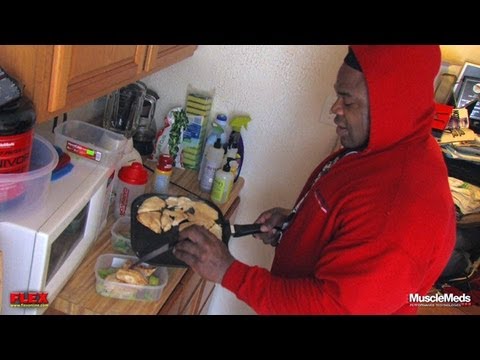
You've seen this.  After the chicken and the vegetables come the sweet potatoes.

As for Froning, he does whatever he wants. Again. Like Leblanc-Bazinet, he relies on lots of protein shakes to get through the day, but at night eats whatever he wants. This doesn't include bread or pasta, which he doesn't like (wtf?). But he does like lots of peanut butter which he washes down with whole milk.

Another huge front squat for Leblanc-Bazinet

3. Strength base. 
Did you know Leblanc-Bazinet did a double bodyweight front squat! 265 at 130! That is fucking strong. The bulk of her training is also barbell training, either building strength with squats and deadlifts or working on her weightlifting technique, as she reports in a recent interview: "I don’t even do a lot of wod … it is a lot of strength training and skill work… some aerobic too... I might do typical sod [skills] 4 times a week but mostly strength work…"
Froning is also strong, showing us what he is capable of with that 377 overhead squat in the games. But he doesn't have a plan for getting there so we'll just not talk about him anymore...

"I just do what I want, dude."

4. Weak point training.
The whole idea of this sport of fitness is to be well-rounded. At least that's the definition of fitness according to some of the the commercials aired during the games. For Leblanc-Bazinet, as a smaller athlete, she needs to be efficient and strong. She has repeated in interviews that weak points are the focus of her training and thus you can see how, being smaller, strength is key. Her coach had this to say about the matter:
"I wouldn’t say that Camille had any major weaknesses. She’s a smaller athlete, so she needed to get stronger to handle the heavier loads we expected [and saw] at Regionals. She had already started to focus on Olympic lifting and was making great progress. We kept that focus and added in supplemental strength and skill progressions. We worked a lot on cycling moderate to heavy loads for multiple reps, and we carved out time for her to continue to develop her gymnastics skills outside of the pressure of the clock. We structured her energy-systems training so as not to impact her strength development and then moved into building her aerobic base later in the season.”(1)

There you have it. After the Games, I looked into the winners and I wasn't surprised to find out what I did. In strongman or any other sport, you must train, eat, and problem solve to reach the highest levels and do so consistently.

Sunday, June 29, 2014

10 Tips for New Strongmen and Strongwomen

Strongman is rapidly growing and whether or not you plan to compete or plan to spice up your current training program, every beginner seems to make the same mistakes.  Though there are more than what I have listed below, I think these 10 are good to start with.

1. Curling the stones. 

After you lap an atlas stone and prepare to load it, it is imperative that you adjust your hand position. You need to put them over the stone with your elbows pointing out and slightly upward. If they are pointing down, you are going to use too much biceps power and put yourself at high risk for a tear. Don't curl the stones!

For more info on stone training, check out this old post: 

2. Curling the log

This is similar to the above in that you don't want to put undue stress on your biceps. When the log is lapped, the handles are facing upward and are slightly turned out. Sit back so the top of your abdominals touches the log. Pull the log in while pushing your stomach out. Now extend your hips violently maintaining that upper body tightness and the log should roll right up onto the top of your chest. 

When you mess this up, you don't pull the log in with your lats and it separates from your core on the clean. This forces your biceps to make up the slack. This will hurt when done over and over again.

3. Yoke height

If you set the pin too high you will be risking dragging and dropping it. If you set it too low, you now have to do too much of a squat to pick it up. That can be taxing and it takes more time to get moving.

While there are many kinds of yokes you will use, I suggest you write down your heights on the Bigg Dogg and Rogue yokes since you will likely see these at some point during the contest year.

4. Learn to continental clean

Lots of guys and gals can Olympic clean and can do so very well. They can rip an axle up to their shoulders without issue and push press or jerk the weight with little effort. The catch is that this is not always possible. In a medley or a press for reps, the weight is often light enough to get away with this. I assume the weights for reps and medleys are supposed to be about 70-80% of most of your maxes. When the weight is above that range, the Olympic clean will only serve very few when using the axle.

My advice is to practice continental cleans from the get go. This is related to a later point: don't just train what you are good at. It takes time to improve on new movements and this clean will be a challenge. But if you're going to be the last man or woman left standing at the end of a max axle press, you're going to need the proper technique. Continental!

5. Squats

I know we all love to back squat but there is a new boss: front squats. As most of your events are front loaded and forcing you to use about a shoulder width stance, the front squat will serve you best in preparation. It will also put more stress on your quads and give your back a break since deadlifts, yoke, farmers, stones, Continental cleans, etc will already put a tremendous amount of stress on your back during the training week.

6. Paleo, intermittent fasting, carb back loading, etc

I will not rip each of these but let's think about their purpose: aesthetics. You should eat with purpose and mine is to be as strong as possible. I don't eat like shit but these are my staples: chicken, beef, turkey, eggs, rice, potatoes, yams, oatmeal, kale, spinach. Eat well, eat balanced, don't skip meals, don't pretend you live in an era of comestible paucity, and you will be better off for it.


7. Cardio

I know the lighter guys and gals don't have as many problems as the bigger competitors do, but nobody should ignore this. I posted on how to get started with cardio for strongman before:   http://powernyc.blogspot.com/2014/05/cardio-for-strongman.html 

The basic idea is that we need to have all 3 energy systems working efficiently to ensure optimal performance. Don't skip it especially if you are gaining weight.

8. Not adjusting your overall training volume

When I started strongman I lifted six days a week. I love training. Naturally I just revised my program and did strongman on one day and kept training six days a week. That didn't feel good. That really did a lot for giving me chronic overuse injuries that have never seemed to go away.  Modulate your volume to ensure recovery now that your loads are heavier and that you are spending more time under tension.

9. Not prioritizing your weaknesses

Too many people dally about with the same exercises and same rep ranges and never think critically about what is keeping them from making to the next level. We all have weaknesses and those are a good start to build your training plan from. Press sucks? Try doing it first in the week with lighter weights to improve technique and higher reps to build more muscle. Deadlift sucks? Try different angles like block and deficit pulls. Do lots of rows to beef up your upper back and stiff leg deads for your shitty hamstrings. Slow? Try agility drills in your warmups and do light events for speed. Increase the weight while maintaining speed. And on and on.

10. Bodyweight
Last I checked there are no wilks scores for strongman. Worry about getting stronger, adding more muscle, getting faster, and let the weight take care of itself.


Wednesday, May 14, 2014

How to use online food logs


By now you probably have a few different accounts at various online food logs. I know I have fitday and myfitnesspal and I can't remember the others. While I don't always use these accounts, I can take the extra time to unfurl a few quest bar wrappers and pull some Purdue chicken packaging from the garbage to figure out my daily macros.

I don't like digging through my garbage all the time so here are a couple of tips for making the most of online food calculators:

1. Enter in about 2-3 days worth of food. Eat as you normally do then enter all your foods in. If you think your diet is pretty good, you can get an objective picture of where it actually is. Then you can go ahead make adjustments. 

1. I will enter my meals in advance to get an idea of what my menu should be. Then I get my groceries and basically eat the same thing every day until I'm sick of it. Then I start over again. 

3. Sites such as myfitnesspal allow you to scan barcodes with your phone or tablet. You can enter in everything from your protein powder to greens supplements to your Purdue chicken.

4. If you need to know better what vitamins and minerals you need to buy, sites such as fitday have a pretty comprehensive list. Then you can purchase whichever specific vitamins or minerals you are deficient in.

5. I wish I didn't have to write this but most people don't know how much protein, fat, or carbs are in the foods and portions they normally eat. Seeing those numbers will help you learn... And the next time someone tells you they had 10 egg whites and 2 whole eggs at breakfast you will know why.

Tuesday, April 22, 2014

Cheap Meal Preparation for Lifters

Eating for the serious lifter doesn't have to be overly expensive or consume all your free time. I see far too many people fuck up their meals by eating out too much (low quality food for the most part) or just not eating enough. Even if you are on a budget and don't have a lot of time, you should look for solutions instead of excuses.

I am not a nutritionist but I have followed near every damn diet under the sun. Yet I keep coming back to a basic bodybuilder type diet high in carbs and protein with only the essential fats. I can prepare all my meals for the week on Sunday and I can do it rather cheaply which is important since I live in Manhattan and my wife and I have a baby.  I don't shop at Whole Foods but I do well at the Spanish grocery store on my block.

Here is what I purchased at the store (for me) and it cost $80.

2 packs chicken breast. Each pack had 4 breasts. I had to split them myself and I peeled the skin off before I cooked them. This will be the protein base for 8 meals.

3 packs lean ground turkey. These will be the base for about 6 meals.

1 grass fed steak. Good for about 2 meals.

1 bag jasmine rice.

5 sweet potatoes.

1 jar natural peanut butter.

1 large container of oats.

6 cans tuna.

1 loaf pumpernickel. 

3 dozen cage free eggs.

1 bunch fresh kale 

1 container spinach leaves 

2 packs frozen broccoli crowns

That's right. That's not that expensive if you break it down to a six day work week and see that I spend less than $15 a day. 

I cook everything on Sunday and fill up about 15 containers for the week. I hardboil the eggs and put them back in their cartons. When I leave in the morning I scoop my oats into another Tupperware, sprinkle some stevia and cinnamon inside and hit the road. So, Monday might look like this:

wake up: 1 liter water, 2 scoops protein, fiber, greens

Breakfast: 3 egg whites, 2 whole eggs, 1 cup oats

Meal 3: 1 chicken breast, rice with kale

Meal 4 and 5: same

Meal 6: protein, peanut butter

This diet has been my base in helping me go from 210 to 240. I bust my ass in the gym and do cardio 2-4 times a week depending on how close I am to a strongman competition and what my big lifts look like for the week. I bring a gallon of water to work with me and drink it before I go home.

I will have the beef meals after my workouts on Wednesday and Friday. I will eat the tuna sandwiches on Tuesday and Thursday when I come home early. I drink fish oil from the bottle when I wake up and when I get home. There are lot of other little things I can mention but those are minutiae and can be expounded on later. The big picture point is that someone with a busy schedule and a child can manage their food expenses, whether bulking or cutting, and prepare all their meals in a relatively short amount of time and for relatively little money.

Since I brought up the bulk/cut dichotomy, this same diet can be applied for losing weight. I would just cut carbs in half for meal 4 and drop them from meal 5 and make sure I eat an extra serving of broccoli or spinach. After my weight loss plateaus I would cut back my protein portions a bit and ditch the peanut butter at night. 

Let me reiterate my main point, it's all very simple and doesn't need to be a pricey or extremely time consuming endeavor. If you want to get big, eat a lot. Eat a lot of protein, carbs and fat. If you tend to get fatter like me, limit yourself to carbs or fat. When you want to trim, start cutting the energy sources slightly or just decrease all of your portions proportionately. The bottom line is to just make it work.