

1. Coaching
While Froning appears to be the roguish cowboy who follows no set plan and basically trains as he wants, Leblanc-Bazinet's coaches program for her. I think this is an important tool that we can easily forget to use. If you pay attention you will also see that many pros and high level amateurs in strongman either have a coach who assists with or designs their program. Plus, there are many more that train with a group that pushes them past their capabilities should they train or plan their training alone. That extra watchful eye and authority you must be accountable to beyond yourself can push you to new heights and expand your own wealth of training knowledge.
2. Diet
Fucking eat already. Leblanc-Bazinet eats like a bodybuilder! She claims to consume 200 grams of protein a day in about six meals! Ok, two of those meals are shakes, but this girl is putting away some calories. She also said in interviews that her main carb source is the sweet potato. High protein, sweet potatoes... Sounds familiar?
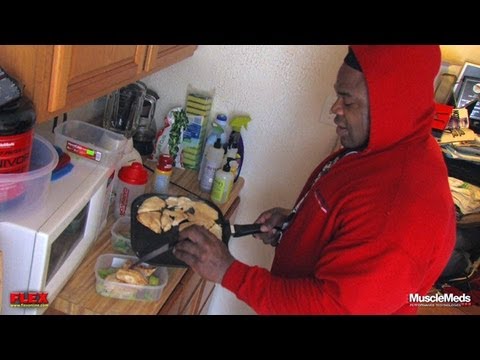
You've seen this. After the chicken and the vegetables come the sweet potatoes.
As for Froning, he does whatever he wants. Again. Like Leblanc-Bazinet, he relies on lots of protein shakes to get through the day, but at night eats whatever he wants. This doesn't include bread or pasta, which he doesn't like (wtf?). But he does like lots of peanut butter which he washes down with whole milk.

Another huge front squat for Leblanc-Bazinet
3. Strength base.
Did you know Leblanc-Bazinet did a double bodyweight front squat! 265 at 130! That is fucking strong. The bulk of her training is also barbell training, either building strength with squats and deadlifts or working on her weightlifting technique, as she reports in a recent interview: "I don’t even do a lot of wod … it is a lot of strength training and skill work… some aerobic too... I might do typical sod [skills] 4 times a week but mostly strength work…"
Froning is also strong, showing us what he is capable of with that 377 overhead squat in the games. But he doesn't have a plan for getting there so we'll just not talk about him anymore...

"I just do what I want, dude."
4. Weak point training.
The whole idea of this sport of fitness is to be well-rounded. At least that's the definition of fitness according to some of the the commercials aired during the games. For Leblanc-Bazinet, as a smaller athlete, she needs to be efficient and strong. She has repeated in interviews that weak points are the focus of her training and thus you can see how, being smaller, strength is key. Her coach had this to say about the matter:
The whole idea of this sport of fitness is to be well-rounded. At least that's the definition of fitness according to some of the the commercials aired during the games. For Leblanc-Bazinet, as a smaller athlete, she needs to be efficient and strong. She has repeated in interviews that weak points are the focus of her training and thus you can see how, being smaller, strength is key. Her coach had this to say about the matter:
"I wouldn’t say that Camille had any major weaknesses. She’s a smaller athlete, so she needed to get stronger to handle the heavier loads we expected [and saw] at Regionals. She had already started to focus on Olympic lifting and was making great progress. We kept that focus and added in supplemental strength and skill progressions. We worked a lot on cycling moderate to heavy loads for multiple reps, and we carved out time for her to continue to develop her gymnastics skills outside of the pressure of the clock. We structured her energy-systems training so as not to impact her strength development and then moved into building her aerobic base later in the season.”(1)
There you have it. After the Games, I looked into the winners and I wasn't surprised to find out what I did. In strongman or any other sport, you must train, eat, and problem solve to reach the highest levels and do so consistently.
There you have it. After the Games, I looked into the winners and I wasn't surprised to find out what I did. In strongman or any other sport, you must train, eat, and problem solve to reach the highest levels and do so consistently.
